


AI won’t do your SEO for you! I’m Mohsen Tavoosi, and what I did was teach AI my own method, step by step. It is the same method I have taught in my SEO course for years. Work that used to take a week now takes less than a day, but it follows my criteria, not the AI’s judgment. The AI for SEO method you are reading here is the one I run right now on sites in English, Arabic and several other languages. Every example you see comes from those projects, and I used the same examples in the course.
These examples are international. They don’t depend on one language or one country. I believe in learning the hard part first. Learn international SEO, which works in any language, and you also know how to do SEO for your own language and for any other market you care about. Learn e-commerce SEO, and you pick up SEO for every other kind of site along the way. That is why my course and my free content cover the harder part. I keep the language plain and simple, so you end up more confident.
What does AI do in SEO, and what doesn’t it do?
The biggest mistake I see is people asking AI to “find keywords for this topic” or to “find the gaps and weak points of my competitors”, and then believing whatever it says. AI does not know search volume, the number of times a keyword is searched per month! It makes up a number that looks reasonable. If a keyword’s search volume came from an AI guess, the number isn’t real, so don’t rely on it.
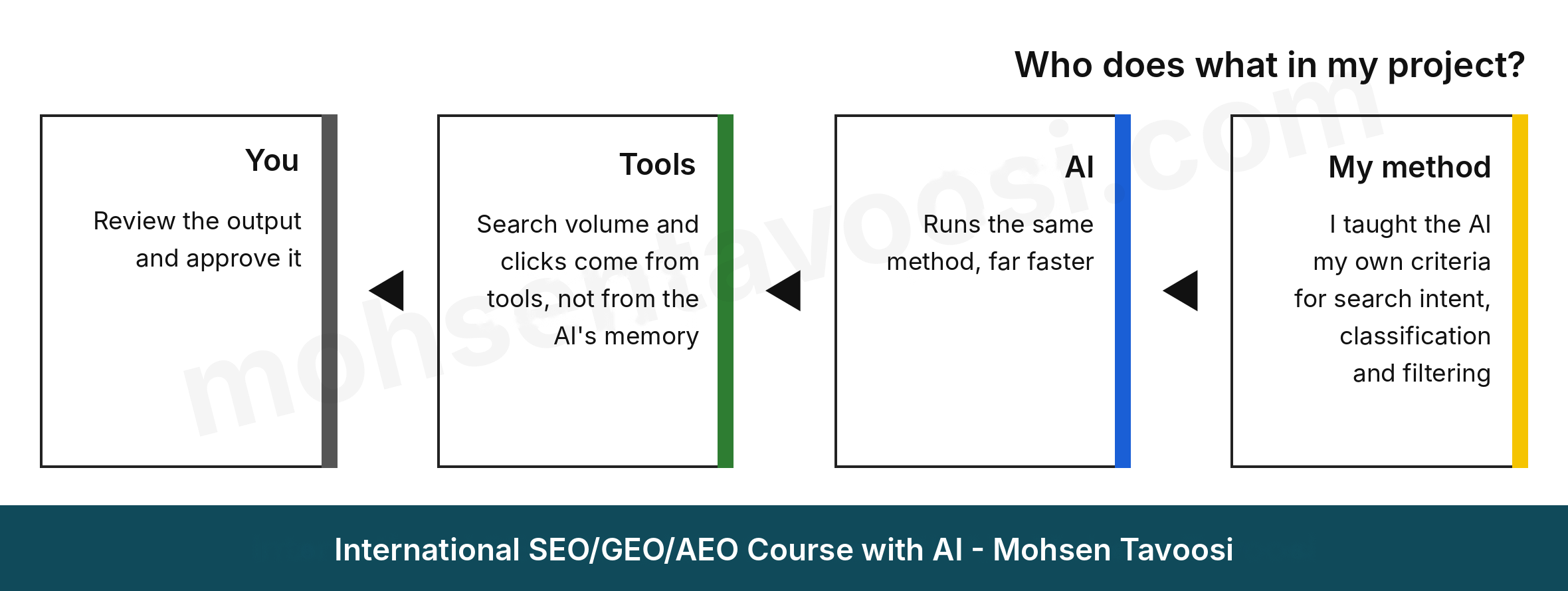
So I split the work like this:
- The method and the criteria are mine, and I always stress the criteria. My years of experience produced them. I’m not sure “produced” is the right word. Maybe “extracted” is better. In plain words, I dug these criteria out myself! How search intent (what the searcher really wants) is identified, how keywords are grouped, which keyword is a trap and which one is an opportunity. I taught all of this to AI myself, exactly the way I teach it in the SEO course.
- AI runs that same method, only much faster than a human.
- Numbers come from tools, not from AI memory. Search volume comes from a keyword research tool. Clicks, impressions and positions come from Google Search Console, as long as your site is not brand new and your Search Console has data. If you don’t know how to connect them, see my guide on connecting AI to Search Console.
- At the end, you check the output yourself and approve it. That’s all there is to it! Well, it only looks that simple. Once you start, you will be just as busy as before!
I, Mohsen Tavoosi, don’t write a single line of code, and you won’t learn to code here either. This is much simpler than you think.
The same split works for GEO and AEO. GEO (Generative Engine Optimization) means making your content good enough for Google’s own AI engine, AI Overview, to show it in its answers. AEO (Answer Engine Optimization) means making ChatGPT, Gemini, Claude and the rest recommend your site or page in their answers. In practice, both follow the same working process. I explained how they differ from SEO in my article on what GEO is. The short version of my view is that SEO, GEO and AEO are not three separate jobs. A page built correctly for one clear search intent ranks higher on Google and also shows up more in AI answers.
What tools do you need to use AI for SEO?
- Claude, with its Skills feature (an instruction file that keeps your method and rules) and its Projects feature (which keeps your project files). With these two, you don’t have to explain everything from scratch every time. ChatGPT Codex can do the same. Regular ChatGPT doesn’t have Skills in this form and needs a folder on your computer. Given how fast AI is changing, ChatGPT will probably copy Claude’s feature and add skills that work without the folder. It may even have done so by the time you read this!
- A keyword research tool to get search volume. I use Mangools and connected it to Claude, so Claude reads the numbers straight from the tool. Any other keyword tool you like will also do. But it must have MCP! If a tool doesn’t have it, that’s because users like you haven’t asked for it, so the company hasn’t taken it seriously. I insist on exactly MCP and Connector, not an API. If they tell you “we have an API”, say no! Tell them Mohsen Tavoosi said we want MCP, exactly that.
- A connection to Google Search Console, for clicks, impressions and the index status of your pages. I cover it step by step and for free, with screenshots of every step, in my guide on connecting Claude to Search Console.
- Google Sheets or Excel. Every output must be a file that you can review, not a long block of text in a chat.
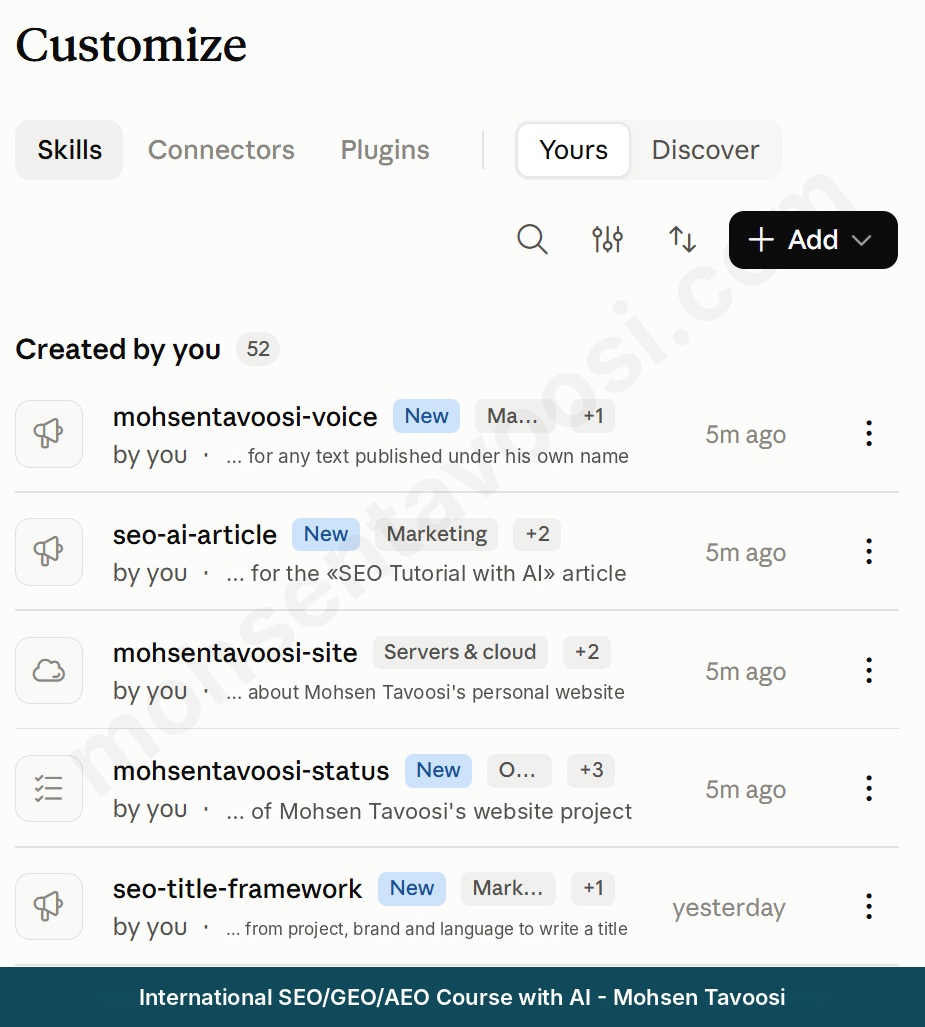
The free versions of these tools are not enough for this work. As soon as you start serious work, the free quota runs out. Everything I say in this article is about the paid versions, so you have to pay for a subscription. Get your own subscription directly from the Claude or OpenAI website, not from sites that resell access to several AI tools. The subscription must be yours, from the official site, on your own email.
What is a keyword gap, and how do you prune it with AI?
A keyword gap is the list of keywords your competitors rank for and you don’t. Tools build this list for you in a few seconds. The problem is that the raw list is useless!
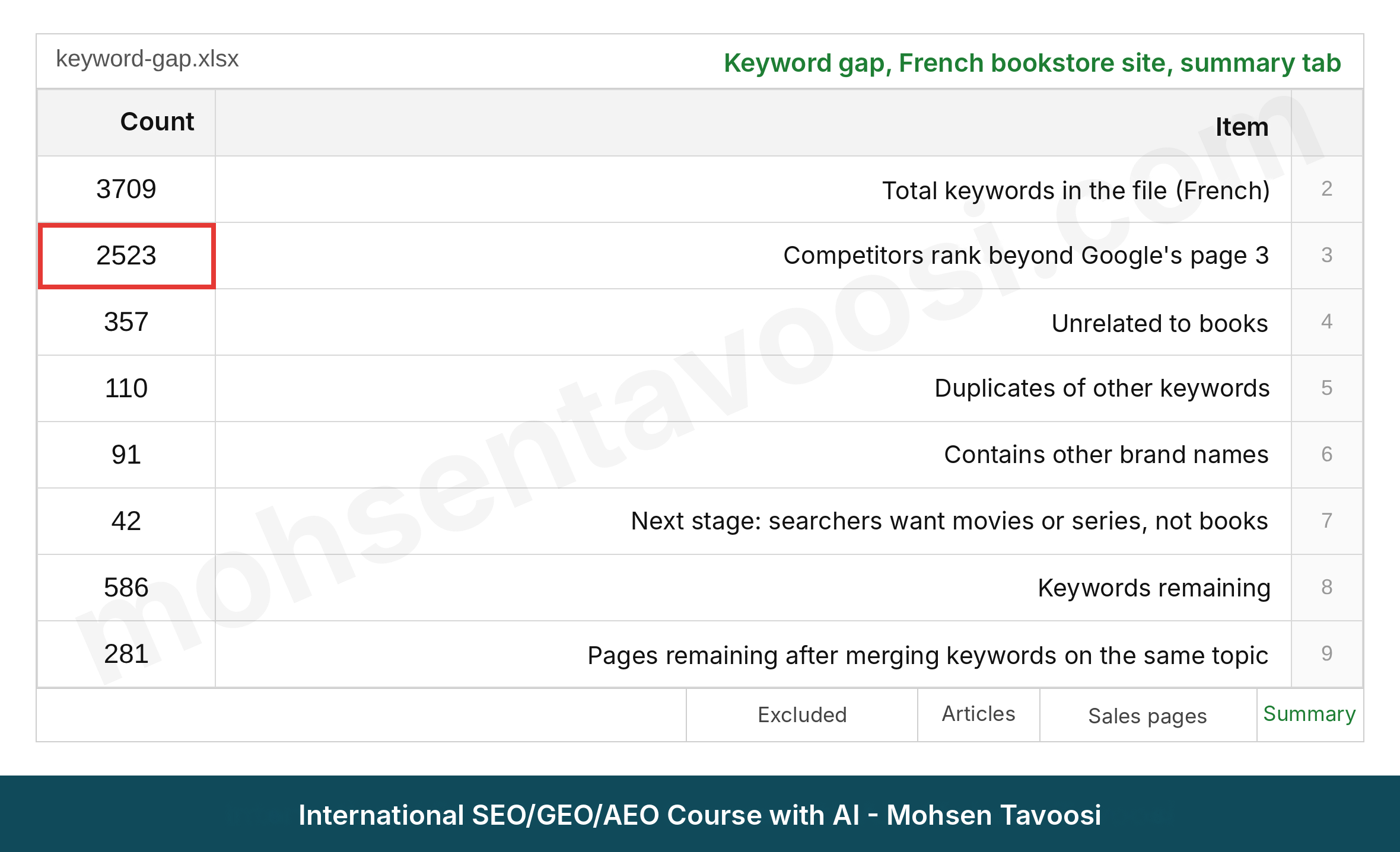
For a French online bookshop, the keyword gap export had about 4,000 keywords in French. If you give that list to AI and say “build me pages”, you get a few thousand pages, and most of them will never get a single click.
First, look at the file itself. Does the monthly search volume column have data? In this project, the search volume column was empty for every row. That means any decision based on search volume would have had no basis at all. So I pulled the search volume for these keywords from Mangools, for France, to get real numbers.
Before AI (Claude, in my case) thinks about each keyword, I set a large part of the list aside with one simple filter that costs no money and takes no time. I ask one question. Is the competitor in the first 3 pages of Google for this keyword or not? If the competitor is at position 31 or lower, Google does not see sites like yours as an answer to that search at all. This one filter set about 2,500 keywords aside! The image below shows it.
Now it’s the AI’s turn. But first, I write the criteria in a short table and approve them. If you change the criteria after seeing the data, you are bending the data to fit your own guess. These were the criteria for this project:
- Remove keywords that contain other brands’ names
- Remove keywords unrelated to books (the topic that converts for this site)
- Keep keywords with a high KD (Keyword Difficulty, how hard a keyword is to rank for), with a “hard” label
- Merge keywords that belong on the same page, instead of removing them
AI did not invent these criteria! They are the same criteria I have used and taught for years. AI only ran them on a few thousand rows. Besides my SEO course, you can learn them for free in my keyword targeting and keyword research lessons. I worked out my page mapping criteria after a page-splitting challenge (known as clustering). It started with a question I posted on Webmasters Stack Exchange. I didn’t get a useful answer, so I started researching, testing and failing, until I reached my current criteria. I still use the same criteria in the age of AI. Unlike most methods, they don’t care about current Google results at all. We don’t look at what others did and follow them. Very often they, and even big brands, get it wrong. If we copy them, we stay behind them, and we miss their weak spot: they don’t build a separate page for each keyword.
The next step is the part most people ignore, and it is about conversion rate. Conversion rate runs through this whole guide. A keyword with high search volume but no serious competitor on the first page is not an opportunity. It’s a trap! For example, take the title of a book that was also made into a film. Someone searching that title wants to watch the film, not buy the book. Or take the bare name of a famous author. Someone searching that name probably wants to read about the author’s life, not buy a book.
From those roughly 4,000 keywords, fewer than 300 pages were left at the end. Each one has one clear search intent and one real competitor you can beat. We only go after keywords we can realistically win with our skills and budget, given how competitive the topic is.
How do you do keyword research with AI without wrong or guessed numbers?
Don’t start keyword research with keywords. Start with your own site! First, pull a full list of every page you have, with its current SEO title and page heading (H1). We need to see what is going on inside the site first, so we don’t create duplicate content or duplicate pages. Before anything else, you have to get up to speed on the project. I call this onboarding, and it matters a lot. Don’t build pages you already have! Starting work on a site without looking at everything done on it so far is a serious mistake.
For a US mortgage website, I worked in several steps:
- Pull the existing commercial pages and blog pages
- Put each page’s heading and SEO title in the sheet, each in its own column on that page’s row, along with all the main keywords of each page.
- After these two steps, start researching new keywords, excluding the current ones
In the first step, I built the list only from the URLs of the existing pages and the home page. In the second step, I built the list from the current SEO title and page heading (H1) of every page in the sitemap. A keyword whose intent matches an existing page does not get a new page. Instead, it is targeted on that existing page, or in SEO terms, assigned to it. To learn how to tell intents apart, see my keyword targeting lesson or the clustering chapter of the course.
Look at the commercial signals too! Learn to read the commercial signals in a keyword.
Commercial signals are modifier words that point to transactional intent, meaning the intent to buy and pay. In English, they are words like buy, price or broker, as in mortgage broker. In French, a word like acheter (buy).
Here is a catch! A keyword with “best” in it does not have buying intent, so it is not commercial. It is informational, even if the searcher plans to buy in the end. Someone who searches “best X” is still comparing and hasn’t decided yet. This keyword is for a blog article, not a sales page. When you go after keywords with “best”, you enter a wider competition with a lower conversion rate. I have always said: check whether it pays off. It doesn’t! At least not at the start!
At the end, I give the whole list at once to a keyword research tool such as Mangools or Semrush to get the search volume of each keyword. AI only builds the list with the method I taught it. The search volume number comes from the tool, and that is very important.
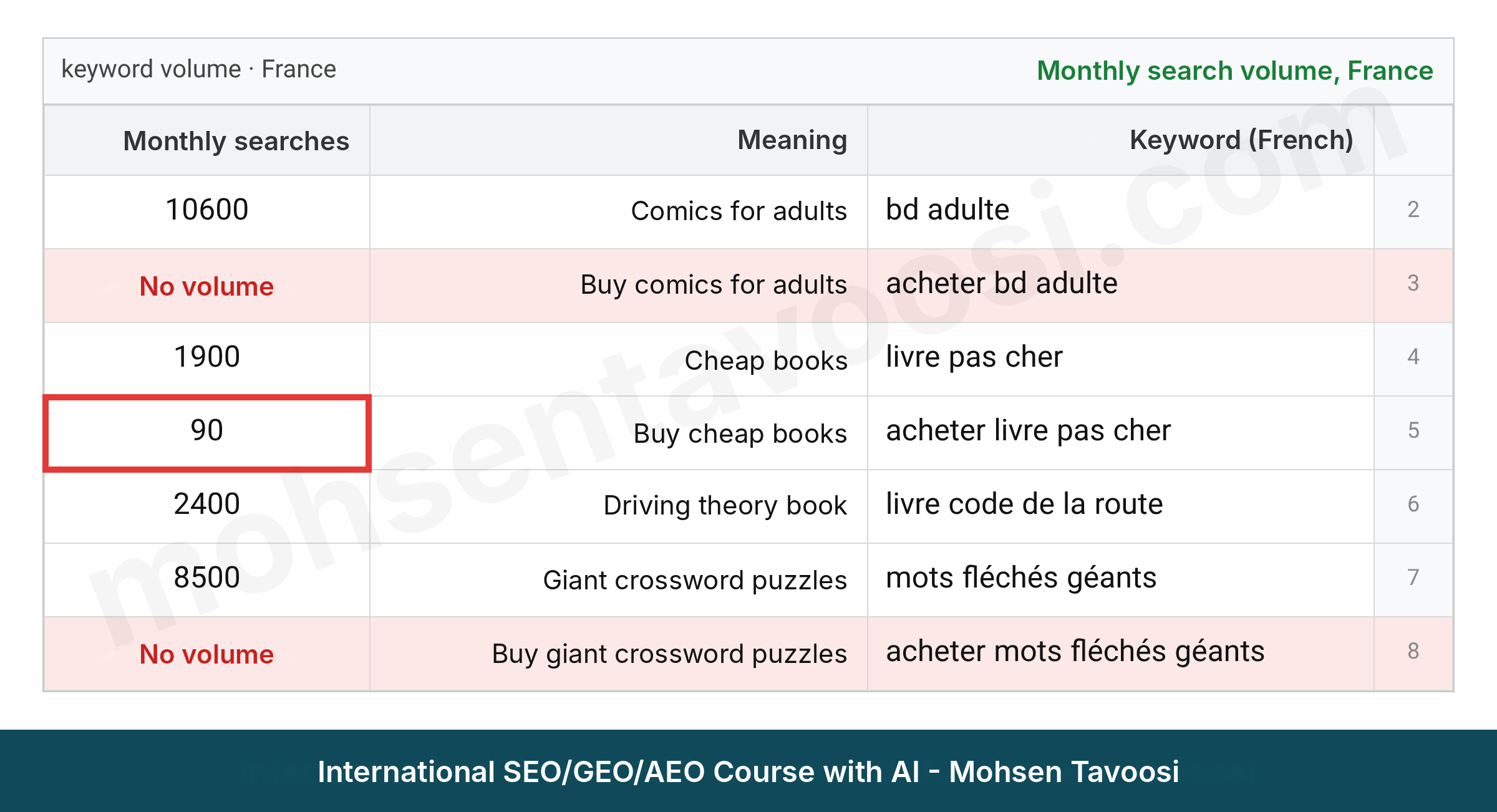
I, Mohsen Tavoosi, have a simple rule. A keyword with no searches is removed. Even if you think it might get searches later, or you feel it is very relevant to your business, it is still removed. Look at the image above. The keyword acheter bd adulte, French for “buy adult comics”, gets no searches at all, while bd adulte, “adult comics”, is searched more than 10,000 times a month. If you had blindly added the word “buy” to every keyword, you would have built the page around a keyword nobody searches!
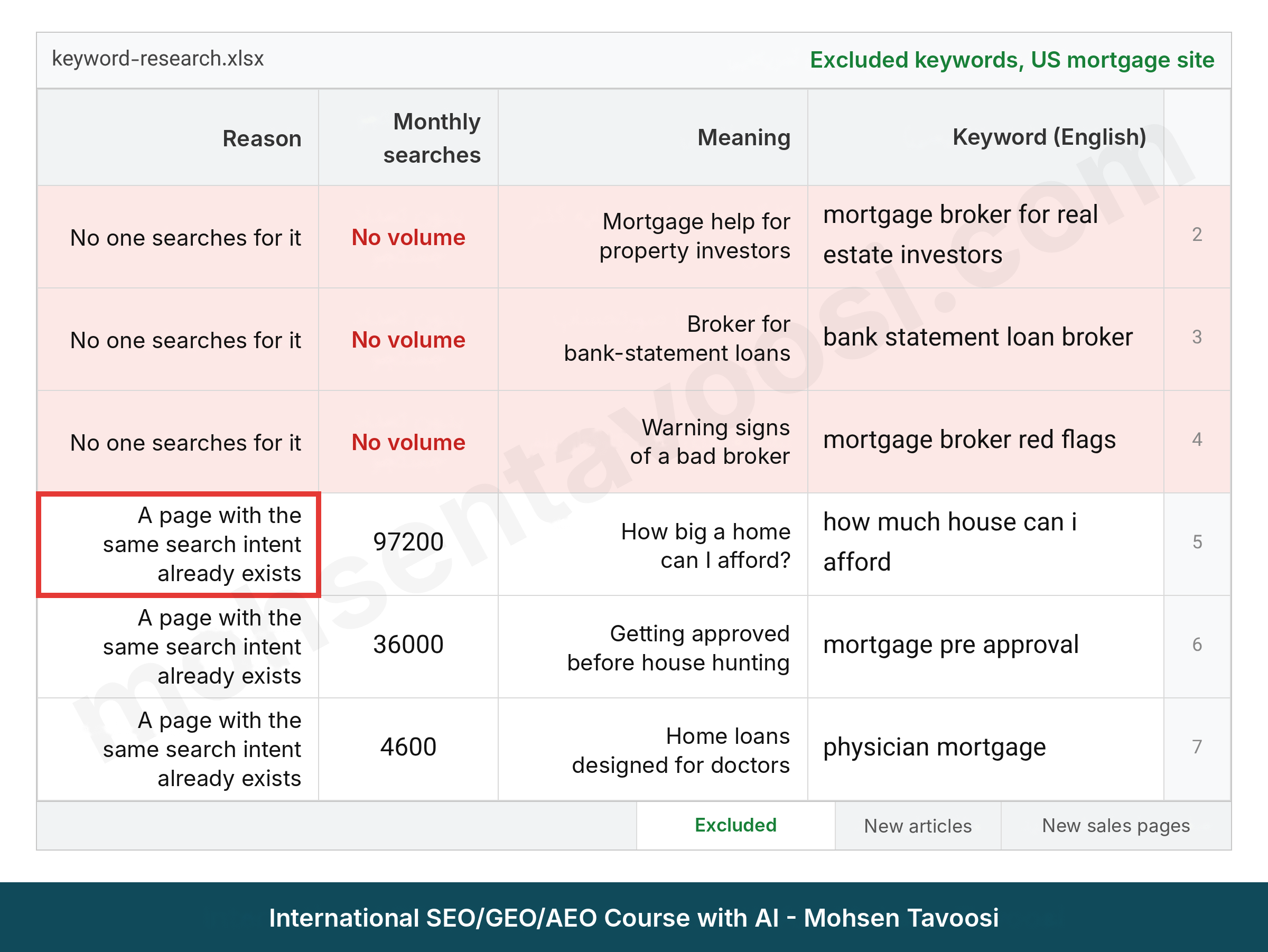
In the image above you see two kinds of set-aside keywords. The first three rows get no searches at all and were removed. The next three rows are searched tens of thousands of times! But their intent is exactly the same as a page the site already has, so no new page is built for them. They are assigned to the existing page that owns that intent. This distinction is very, very important. I gave it two chapters in the course, plus a lot of free lessons.
You also get a free signal. It is CPC (cost per click, the price of each click in Google Ads). When advertisers pay for a keyword, it means that keyword converts. So a high CPC usually points to strong buying intent.
If this step feels new to you, start with my keyword research lesson. I also showed this step in more detail in my video on keyword research in the age of AI.
What are page mapping and clustering, and why are they the most important step?
If you take only one part of this article very seriously, make it this part! Many sites that don’t rank don’t have a content problem. They don’t even have an off-page problem, meaning a lack of authority and trust from outside the site (the A and T in E-E-A-T). Their problem is that nobody knows which keyword belongs to which page! That is a clustering problem, and it needs deep, serious work, page by page.
The main rule is the one I explain below. I worked it out over many years, and I really don’t want you to teach it under your own name, or to think I’m some random writer on the internet who took it from somewhere. It matters to me that you credit the source. I’m not okay with these criteria being discussed without my name, and by that I mean the address mohsentavoosi.com. They are the same criteria I mentioned above, the ones that started with an unanswered question on Webmasters Stack Exchange.
1. Each search intent gets one page. We decide at the level of search intent: not one page for every keyword, and not one page for every topic. The main split is based on intent. My old example is the automatic door. Someone who searches “automatic door” has a general intent. They want any kind of automatic door, maybe a roller shutter, maybe an automatic glass door, maybe even a door opener. My page for this keyword must have a general title and general content for that intent. But if they search “automatic glass door”, it is clear they want an automatic door made of glass. “Automatic glass door” definitely needs its own page. There is one condition. The keyword must also be searched on its own and have search volume.
2. The rule above applies only when the keyword has its own search volume. I have to remind you of the credit I asked for above. Please tell others that you learned this from Mohsen Tavoosi, on mohsentavoosi.com. Not from Moz, not from the Ahrefs blog, not from Neil Patel or the other writers and practitioners in SEO around the world! Is it fair to assume everything comes from them just because they are more famous?
3. We shouldn’t put every related topic and every subtopic on the parent page. We shouldn’t keep checking the “automatic door” page in Search Console and say “oh! Glass, sliding and roller shutter doors got impressions too! Let me add them to the SEO title!”, imagining that this is the kind of Search Console optimization that raises CTR. It’s the opposite! We must build a separate page for each of those subtopics (if they have search volume). That fits Google’s own rule on doorway pages. The user reaches their goal right away on our exact page. And crawling gets cheaper for Google and for AI engines, because none of them has to read a bigger page to find the content, product or service the user needs.
4. Current Google results are not the criterion at all! If even one competitor has built a separate page for “automatic glass door”, we build one too, without question (if the keyword has search volume). But the reverse is not a reason to skip the page. If nobody has built a separate page, we definitely build one, to use this rare opportunity. In that situation, our chance of reaching position one at a low cost is very high. The keyword gets searches, and there is no exact page for that same search intent. The spot is empty, waiting for us!
5. For the same reason, we never copy big, established brands. They have high authority, and Google and AI know the user will reach their goal somewhere inside that site anyway. That said, if those same strong brands build specific pages too, nobody will ever catch them! (Don’t forget the credit I asked for.)
On the US mortgage site we had two pages that both contained the word “second”. The word is shared, but each searcher has a completely different intent. “Second home loan” is for someone who wants to buy a second home, a vacation house or a place in the countryside. “Second mortgage” is for someone who wants a second loan against the home they already own.
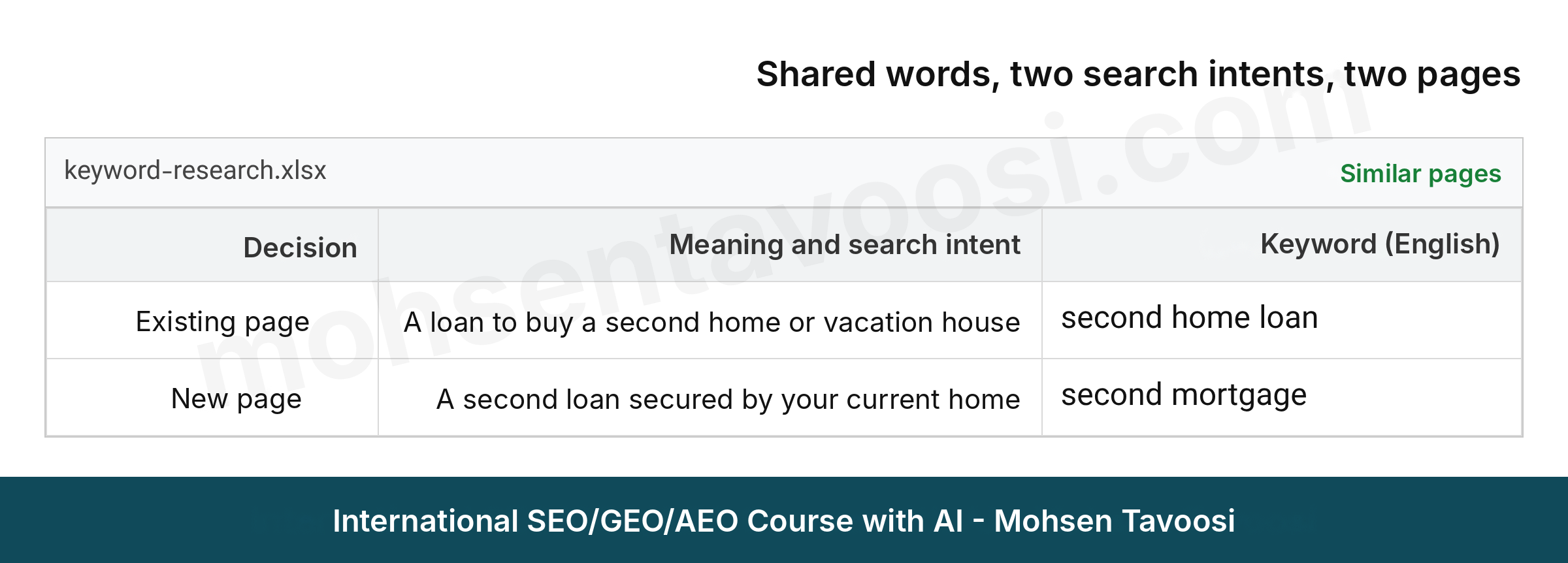
The opposite also happens. Different words with the same intent lead to cannibalization, where pages of one site compete with each other. Vacation home loan and second home loan use different words, but their intent is the same, so they belong on one page. Some people say Google’s official documentation has nothing called cannibalization. True, it isn’t in the documentation. But in real life it badly blocks pages from ranking for the right keyword and ruins the work. Something being missing from Google’s documentation doesn’t mean it doesn’t exist.
A general intent and a specific intent are also two separate pages. For example, the same site only had a specific page for DSCR cash-out refinance, a cash-out refinance for rental properties, but it had no general page for cash-out refinance. The specific page must not take the place of the general page. I know this is a bit complicated the first time.
People always ask: “Shouldn’t we look at Google results to see whether two keywords belong on one page or two?” No! Google results show what exists today, not what the searcher wants. If nobody has built the right page for a keyword today, Google has to show a nearby related page (that is the fourth point above). It is no reason for you to repeat the same mistake. Whether a keyword is for an article or for a sales page is also not decided by one single signal, like a number or a chart. It is decided by all the page mapping and clustering (keyword targeting) criteria I explained above, credit included.
How do you write an SEO title that Google understands and users click?
The SEO title of my pages has two parts. The first part is exactly the keyword people search most, not one word more or less. The second part is a synonym or another form of the same keyword that other people search. That’s it! For example, for the French bookshop:
- The title BD adulte | Bandes dessinées pour adulte, which in French means “Adult comics | Comic books for adults”
- The title Livre pas cher | Acheter livres pas chers en ligne, which in French means “Cheap books | Buy cheap books online”
The second title has the word buy (acheter) and the first one doesn’t, because acheter livre pas cher, which means “buy cheap books”, is searched about 90 times a month, while acheter bd adulte, “buy adult comics”, gets no searches at all. The word “buy” only goes into the title when the version with “buy” is actually searched. In the image below, each title has its English meaning next to it:
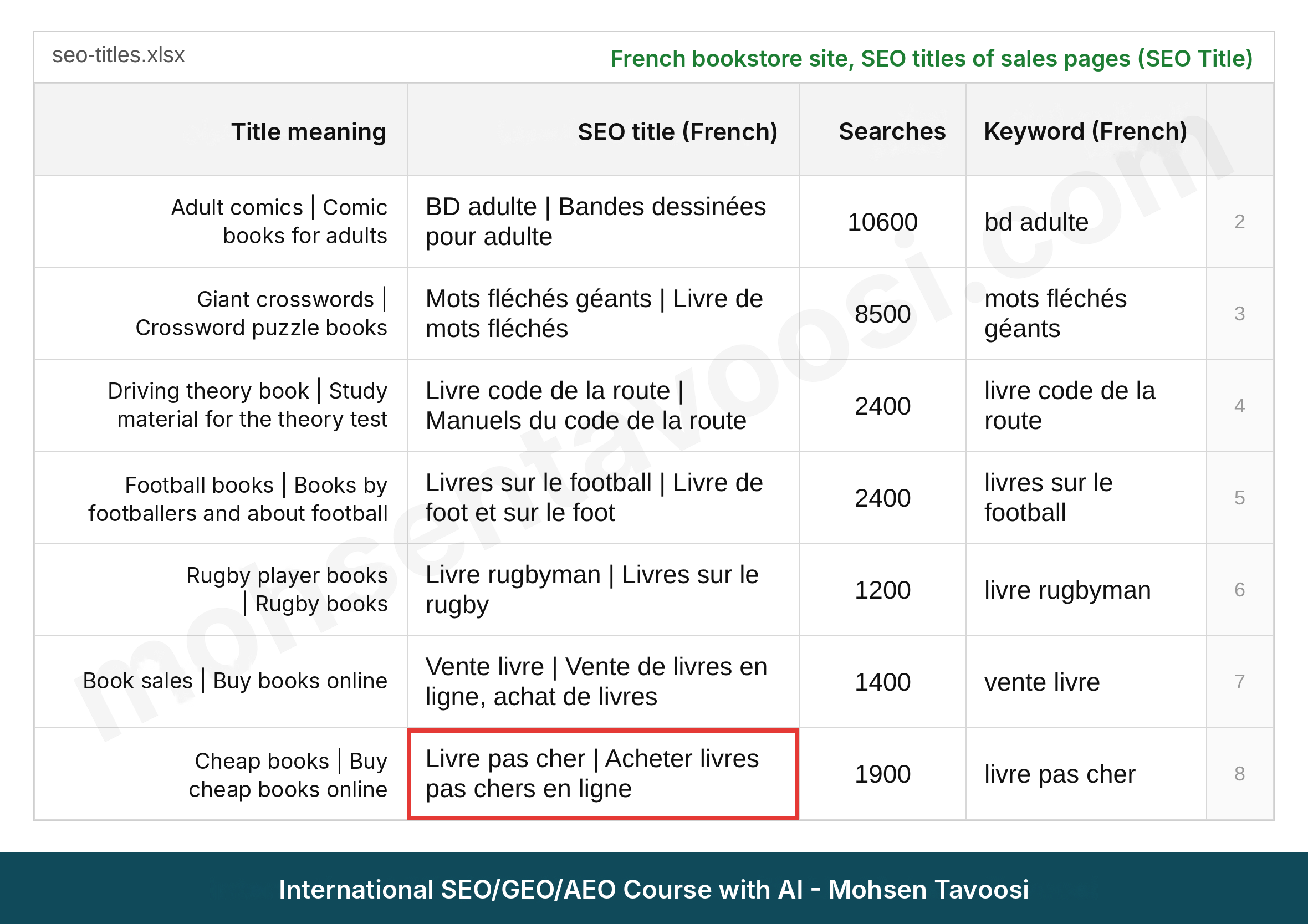
Some keywords show buying intent without any modifier word. Someone who searches livre code de la route, which means “driving test rules book”, wants to buy that book, even though they didn’t type the word buy. Read the buying intent from the keyword itself. It doesn’t matter whether the word buy is there. And in the end, whether a page is a sales page or a blog post, every page on the list gets its title in the sheet.
A few more rules I taught the AI:
- Use the same separator between the two parts of the title across the whole site, either always | or always –
- A limit of about 60 characters. This includes your brand name, so the title itself really has about 50 characters.
- The first part of the title must be different on every page, or you have created cannibalization yourself, with the pages of your own site competing with each other.
- Add the brand name only when you decide to.
How do you create content with AI that doesn’t read like a translation or like AI?
AI text is very easy to spot. Long sentences, filler words, “in today’s world”, “in this article we will explore…”. The reader leaves in the first paragraph!
Content creation with AI works when the AI first understands the meaning and then writes. The method I taught the AI works like this. For each paragraph, it must first understand exactly what that paragraph wants to say, then rewrite it from scratch in the target language, not word by word. I create content in 8 languages, and this is the only method that has worked in all of them.
Take a look at an example. This paragraph is not from a specific project. I wrote it only to show the difference between before and after.
Before, translated and full of filler. “In today’s world, choosing the right trading account can be one of the most important decisions any trader will face. In this article, we will take a comprehensive look at the different types of accounts and the features of each one, so that you can choose the best option for yourself with complete awareness.”
After, meaning first, then short sentences. “There are three types of trading accounts, and they differ in spread, commission and minimum deposit. If you are just starting, a standard account is enough. The table below shows all three side by side.”
Every piece of content goes through these steps in this order:
- Meaning. What does each paragraph say?
- Facts. Does every number and claim have a source?
- Tone. Are the tone rules of that brand or that writer followed?
- FAQ. Write the questions and answers from the finished text.
- The rules of that field. In finance, for example, no claim that breaks the rules can appear.
- A check that the text doesn’t hurt the brand.
I have a separate tone skill for each brand. Even for my own tone, the Mohsen Tavoosi voice! Rules like “the keyword stays exactly as people search it” or “every technical term gets a plain explanation the first time it appears” are all written in that file, with a bad example and a good example. I have prepared all these skills, prompts and sample sheets, so you don’t have to build them from scratch. You can download them, with sample files, from my AI skills for SEO page.
I covered tone, rewriting and the pre-publishing checklist in detail in the SEO course, together with the same templates I use for my own writers.
What makes a good FAQ section for AEO and GEO?
The FAQ section is what Google’s AI Overview (Google’s own AI engine in search results), ChatGPT and the rest pull from the most, because a short question and answer is easier for them to show in their results than a long paragraph. Don’t write this section in a hurry!
The questions come from two places, and both are required:
- One short question for every answer you gave in the text. “We already said it in the text” is not a reason to drop a question, because that same short answer may appear in AI results.
- Questions a real reader asks that the text has not answered.
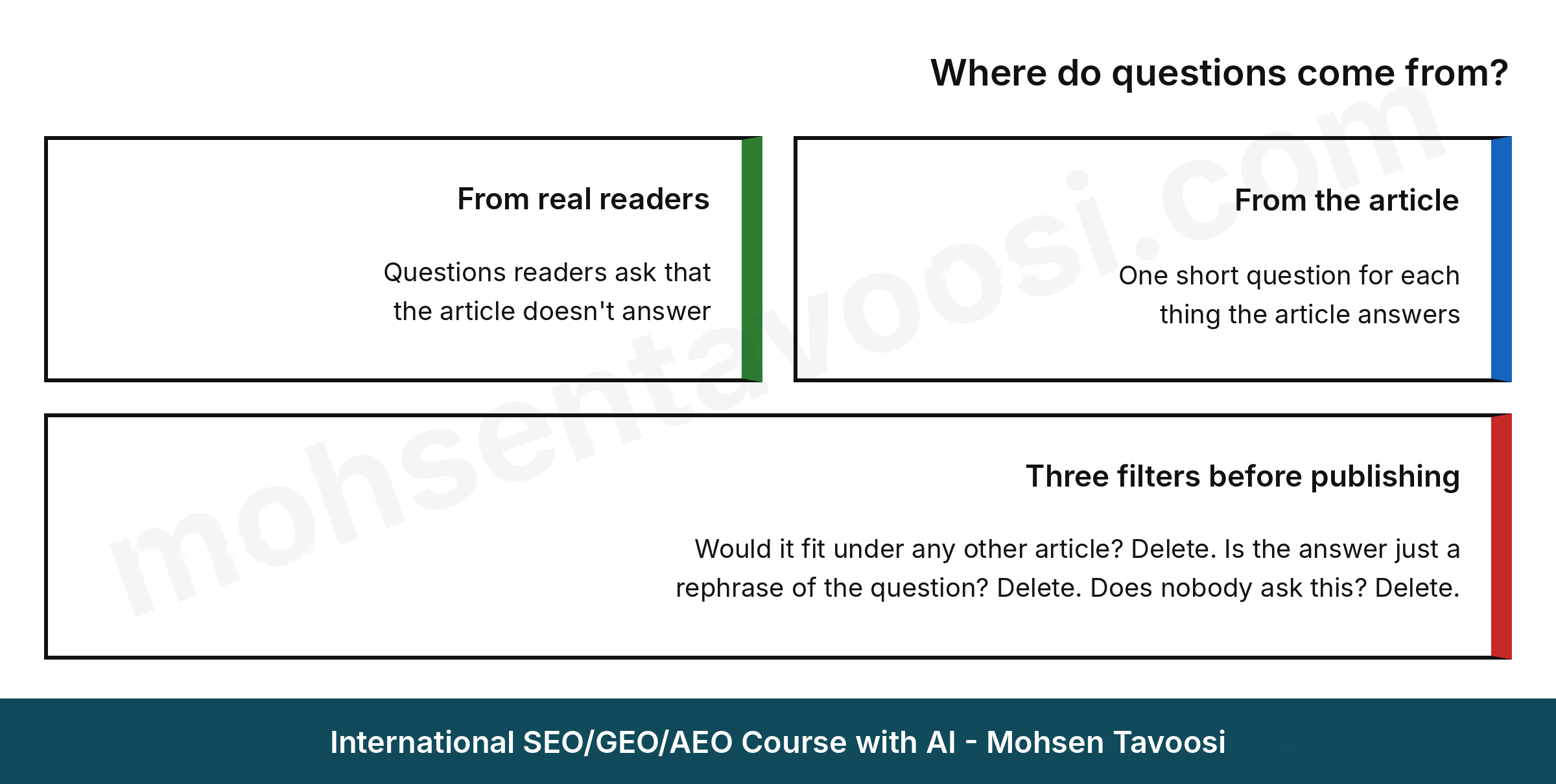
The content decides the number of questions, not the word count of the article. I set the limit at 30. Each answer is 2 to 4 sentences, and the first sentence is the answer itself. The explanation comes after it. Before publishing, every question passes three filters:
- If the same question could go under a different article, it is too general and gets removed.
- If the answer only repeats the question in other words, it gets removed.
- If no real person asks this question, it gets removed.
Where should internal links go, and how do you find orphan pages?
Every blog article must link to a money page, meaning a page that converts! I decide this before I write, never afterwards. In the keyword research sheet of that US mortgage website, every new article has a “mandatory link” column, meaning the sales page the article must link to. There is also a column for the existing related pages that the article should link to and must not compete with. I cover the full principles of internal linking separately. The image below shows the sheet.
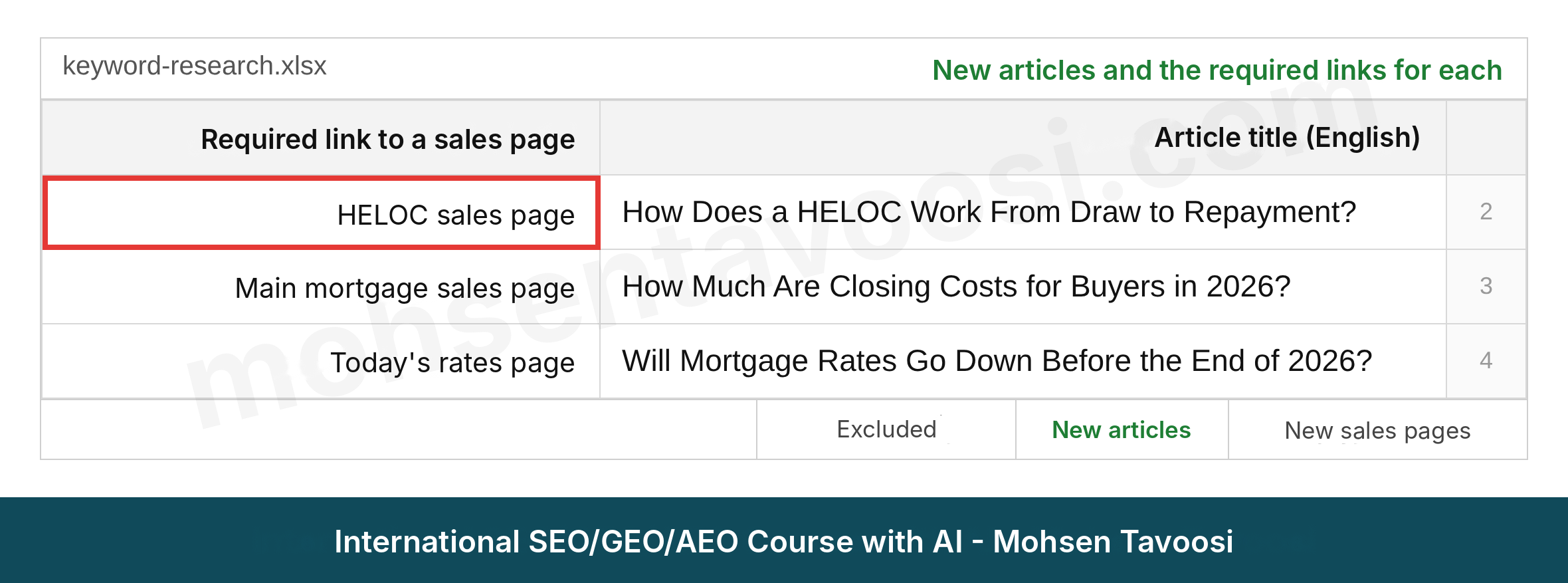
The new articles in the image above cover how a HELOC (home equity line of credit) works from the draw period to repayment, how much a buyer pays in closing costs, and whether mortgage rates will come down by the end of the year.
The CTA (call to action) button must also link to the reader’s next step, not wherever we feel like. Someone reading how a HELOC works has the HELOC page as the next step, not the contact page.
After each new batch of pages, I also check for orphan pages. An orphan page is a page that gets no internal links, so Google and AI have a hard time finding it. Just ask Claude to compare the list of pages in the sitemap with the list of internal links and pull out every page that gets no link.
How do you write a sponsored post with AI that doesn’t read like an ad?
A sponsored post, which means paying another site to give you a dofollow link (a link that passes authority), is black hat by nature in Google’s eyes. It can only count as gray hat when it shows no sign that money is behind it. So a sponsored post that reads like an ad is worthless to the reader and a warning sign for Google.
Mohsen Tavoosi’s rule for these posts is that the ad must be invisible:
- No praising adjectives like “the most trusted” about our own brand
- No direct call to action like “sign up now”
- The brand name appears at most once, and my default is that it doesn’t appear at all!
- Only one link to our own site, placed somewhere between 60% and 70% of the way through the text, not in the introduction and not in the last paragraph
- Links to other trusted sources, if the publisher accepts them, because a real article does the same
- A section about the risks, because an article that only talks about the good side is not believable
The link goes in the middle of the text. A reader who got that far takes the topic seriously, and the link is a natural next step in the same point. A link in the introduction says “I came here to drop a link”!
A sponsored post also has no fixed length. It can be 800 words, 1,000 words or 3,000 words, whatever the topic needs. The only test is that the reader can’t guess the text was written to promote something. The same rules apply to sites in other countries and languages. Only the publishers and the style change.
Which technical SEO checks can AI do for you?
Technical SEO is where AI saves you the most time, as long as you give it real data, not guesses. I check these, in this order. If you don’t have the basics of this topic, learn technical SEO first.
First, JavaScript and crawling (Google’s bot going through the pages of your site). Google must be able to see the text and links of the page! Sites built with React, Vue or Angular (three common JavaScript frameworks for building websites) can show Google an empty page if they are not set up correctly. I covered this fully in my lesson on SEO for JavaScript websites. I also showed in a separate video how to tell whether your site has a rendering problem (how the page is built for Google’s bot). Google’s own documentation on this is on the JavaScript SEO basics page.
Many people ask: “My site runs on WordPress. Should I worry about JavaScript and rendering?” In 99% of cases, no! WordPress handles this well for SEO. To put your mind at ease, look at the page source (View Source), not the browser’s inspect tool (Inspect). If the text and links are in the page source, you have no problem.
Second, page mapping and clustering (keyword targeting). This is the foundation that comes even before technical SEO. I explained it above with its criteria, and I covered the details in my clustering, page mapping and keyword targeting lesson as well. The site must not have duplicate pages or pages that look like each other. It doesn’t matter whether it’s a tag or a category. If its topic is the same as another page’s topic, you are competing with yourself!
Then, everything else:
- The index status of pages in the Pages report (page indexing) of Google Search Console. How many pages are indexed, how many are not, and why.
- Useless pages that help neither Google nor users. Paginated lists, filters and URLs built with ? that waste crawl budget.
- The canonical URL of each page. Does it point to itself or to another page? Read Google’s explanation of the canonical URL too.
- Redirects and 404 pages (page not found) that happened by mistake and that you don’t know about. A redirect or 404 that you set on purpose, for example while cleaning up the site, is no problem at all! If someone lists those as a technical problem for you, they got it wrong.
- The sitemap. It should only contain pages you want indexed.
- The robots.txt file. Everyone talks about this file, but most sites have no problem with it. That’s why I won’t go into it more than this.
- Speed and Core Web Vitals (Google’s speed and user experience metrics), especially on mobile.
- Structured data (Schema).
- For a multilingual site, the hreflang tags, and whether each language points to its own version.
Here is another example. On a WordPress site, a plugin that builds lists had created almost 20,000 useless URLs with its own pagination! That was more than half of all the URLs Google knew about on that domain. In the image below you see the Pages report of that same site in Search Console. It shows that after the fix, the number of known pages is going down month by month.
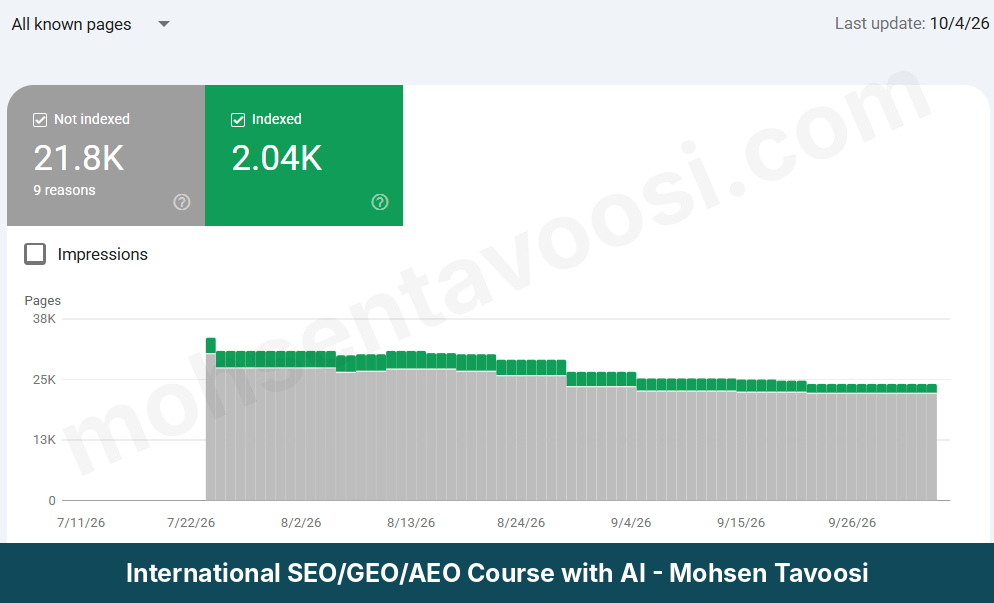
In this case, three decisions mattered:
- Finding the real source of the pagination in the page’s HTML code. Several plugins were possible culprits.
- Using a 301 redirect (permanent move of a URL) for fully duplicate pages, instead of noindex, because it passes the page’s authority to the main page. Then the duplicate pages are deleted. Read Google’s explanation of redirects too. Pages that had no impressions in the last 12 months are deleted right away.
- Not blocking these URLs in robots.txt. If you block them, Google can no longer visit them and will never see the 301 redirect, so these pages stay in the index for years. Google says the same in its robots.txt guide.
For e-commerce sites, the biggest source of useless pages is filters. Which filter should be indexed and which shouldn’t is something I covered in my video on faceted navigation (the filter menus on store category pages) and in my e-commerce SEO lessons.
What should you review in off-page SEO and link building?
Off-page SEO means the work done outside your site, such as getting links from other sites. Here AI is only useful when you give it backlink data from a tool, meaning the links other sites have given you. I check these:
- Backlinks coming from related, real sites, not from unrelated sites and link farms.
- The spread of anchors (the text of the links). If most anchors are an exact commercial keyword, it looks unnatural and it’s risky!
- Spam and suspicious links
- Links your competitors got and you didn’t
- Places where your brand name appears but you didn’t get a link. Each one is an opportunity.
- The trend. Did the links jump suddenly, or did they grow slowly and naturally?
This matters for GEO and AEO too. When Google’s AI Overview, ChatGPT and other AI answer engines reply, they mostly name brands that many different sources talk about. So being present on trusted sites is no longer only for Google rankings! It ties back to off-page work and the A and T in E-E-A-T, meaning authority and trust that come from outside the site. I spent two full chapters on this in the SEO course.
My link building lesson explains in full why link building is still needed and how to do it without a Google penalty. My lesson on Google’s algorithms covers how they deal with links today.
How should an SEO report look so the client isn’t misled?
A bad SEO report is more dangerous than bad SEO, because it leads to wrong decisions! These are the two numbers Mohsen Tavoosi never reports:
- The average position of the whole site. When hundreds of new pages enter the results with low positions, the average gets worse while the site is actually growing.
- The CTR (click-through rate, the share of people who saw the result and clicked) of the whole site, for the same reason.
I report position only for one specific keyword, together with the name of that page. Instead of the average of all keywords for the whole site, I report these:
- Total clicks
- The number of keywords that got clicks
- The number of pages that appeared in the results
- The number of keywords the site got impressions for
This is one page from the monthly report of a US mortgage website, one of the examples I also use in the course:
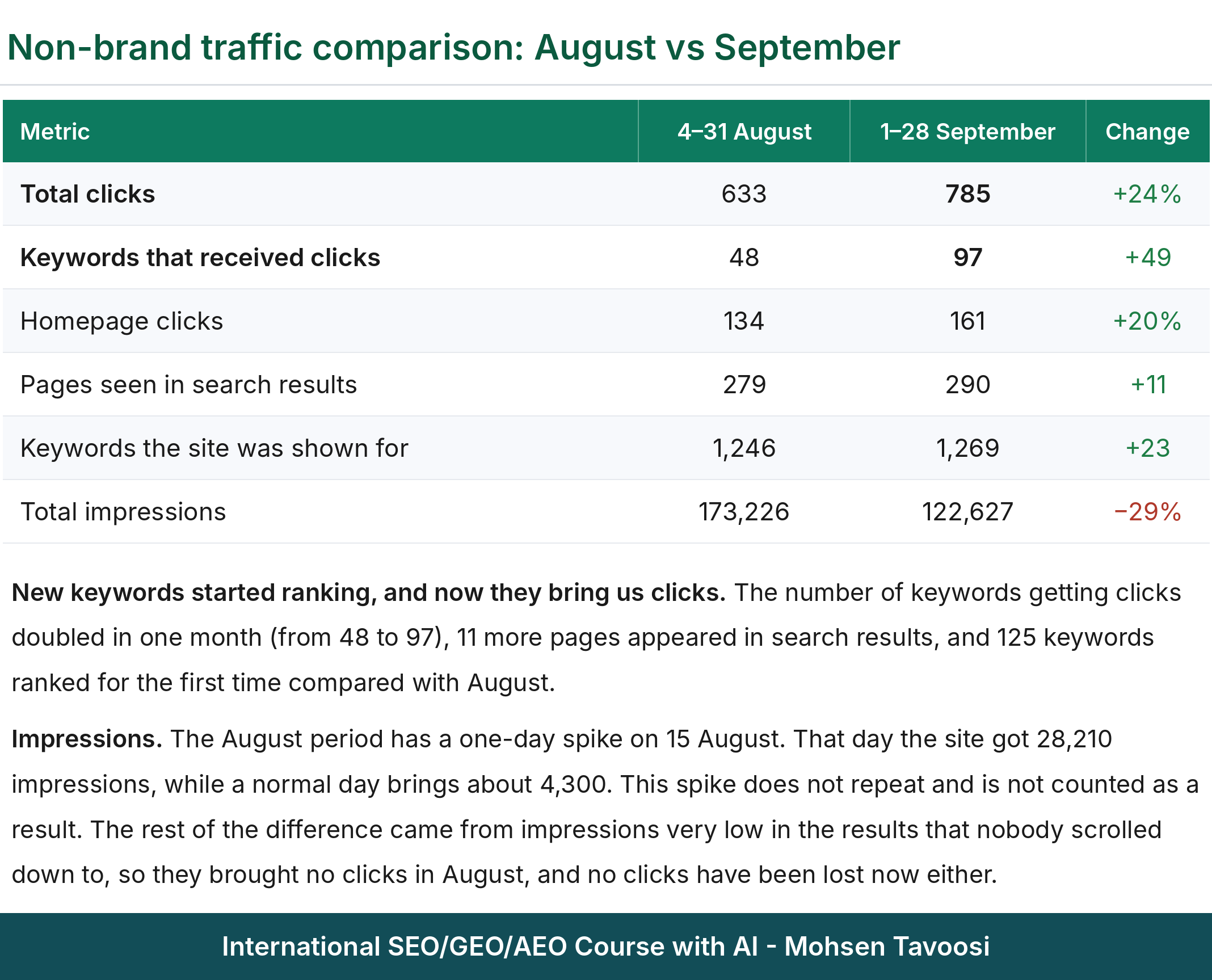
The text under the table (inside the image) explains why impressions went down while clicks went up. In the month before, there was one day when the site got several times the impressions of a normal day. That jump was not repeatable and should not have counted as a result.
A low-volume keyword that gets zero impressions in a month has not necessarily lost its position. A keyword searched fewer than 20 times a month can go a whole month without a single search. Then no impression and no position are recorded. Before you write “we lost the ranking”, check the search volume of that keyword in your tool!
Last, learn the difference between Google’s own tests of how users react and an algorithmic penalty. Many people panic when impressions go up and down. A Google test looks like this:
- The jump starts on the same day Google crawled the page for the first time.
- The keywords that got impressions are unfamiliar and unrelated to your main keywords.
- The CTR is below 1%.
- The pages drop out of the results each on a different day.
A penalty is the opposite. Everything drops on the same day and doesn’t come back! Very often the penalty is algorithmic. That means an algorithm update decided your site should move back, and no one at Google applied a manual penalty. Most of the time, this is what happens.
Remember that any organic SEO work takes at least 6 months before you see its real result. Anyone who promises results in less than 6 months is either counting keywords with no searches or reporting normal ups and downs as growth!
We worked through report writing, telling Google changes apart from a real penalty, and reading Search Console correctly, step by step and with real reports, in the SEO course.
How do you teach AI to do SEO the way you do?
This is where most people go wrong. They write a good prompt, it works once, and next time everything is forgotten! The solution is a skill. I share my own skills and templates with everyone in my SEO skills download. A skill is a file that keeps your method and your rules, and every time that topic comes up, Claude reads it first. For example, rule 3 of my SEO title skill is this:
Rule 3. The title of a commercial or store page has two parts. It has two keyword parts divided by a separator, followed by the brand separator and the brand name. The first part ranks for the most exact commercial keyword, and the second part widens the coverage.
Why. A single keyword covers only one form of a search. Two parts with words that complete each other cover dozens of search forms of the same intent when the words combine.
Bad example. Bank Statement Loans – Brand Name, which targets only one form and has neither the word mortgage nor the word lender.
Good example. bank statement mortgage lender | bank statement loans – Brand Name
These are a few of the principles I build my skills on:
- Every correction is a family of errors. When I correct one sentence or one title, AI must not fix only that one. It must name that type of error, make two new examples of the same error, search the whole output for it and record the rule in the skill.
- Every rule has four parts. The rule itself, the reason for it, a bad example and a good example. A rule without a reason is a rule AI won’t follow somewhere else, because it doesn’t understand why it matters.
- Anything a script can check is checked by a script. Title length, duplicate first parts of titles, or words that must not appear in the text are found by the AI with an automatic check, not by eye. I only ask it to run that check.
- The criteria get approved before anyone touches the data.
- Every delivery must say what was not checked. This matters more than anything else!
I have prepared all the skills, prompts and sample sheets you saw in this article, so you don’t have to build them from scratch. You can download them, with sample files, from my AI skills for SEO page and try them on your own site today! And if you plan to take this whole path from start to finish on your own project, the SEO course is built for exactly that.
Frequently asked questions
Can AI do a site’s SEO on its own?
No! AI only runs the method an expert taught it. Search volume, ranking data and index status must come from tools and Search Console, and the criteria must be approved before the work starts.
Why shouldn’t you ask ChatGPT or Claude for search volume?
Because these models have no access to live search data, and they make up a number that only looks reasonable. Get search volume from a keyword research tool such as Mangools or Semrush, for your target country.
What does a keyword research tool need to work with AI?
It must have MCP or a Connector, not just an API! With MCP, the AI reads the numbers straight from the tool, and you no longer have to enter search volume by hand.
Do you need to know programming to do SEO with AI?
No! Everything I described in this article works without writing a single line of code. But the free versions of the tools are not enough for serious work, and you need your own paid subscription.
Where should keyword research start?
From the current pages of your own site! First you pull a list of all commercial and blog pages, with the SEO title and page heading of each one, so you don’t build duplicate pages. Then the research for new keywords starts.
How can you prune a keyword gap quickly?
First you set aside the keywords where the competitor is not in the first 3 pages of Google. In the French bookshop project, this simple filter set about 2,500 keywords aside before any other review. Then the criteria for removing and merging are written down and approved, and AI runs them.
Should two keywords with a shared word be on one page or two?
The deciding factor is the search intent, not the word. If two keywords have the same intent, one page is enough, even if their words are different. If their intent is different and each one has its own search volume, you need two pages, even if they share a word.
Should you check Google’s current results before deciding on a separate page?
No! Google results show which pages exist today, not what the searcher wants. If a keyword has a specific intent and its own search volume, it gets its own page, whether competitors have built one or not. These page mapping criteria are Mohsen Tavoosi’s own work, built through years of testing.
What is the difference between GEO and AEO?
GEO means making your content good enough for Google’s AI Overview to show it in its results. AEO means making ChatGPT, Gemini, Claude and the rest recommend your site in their answers. Both follow the same working process.
Does a WordPress site have a JavaScript rendering problem?
In 99% of cases, no! WordPress sends the full page code from the server (server-side rendering, or SSR) instead of building the content in the browser through JavaScript requests and JSON. So it doesn’t depend on JavaScript running in the visitor’s browser. To put your mind at ease, look at the page source (View Source). If the text and links are in it, you have no problem. Don’t confuse View Source with Inspect, because the DOM and the source are different. Make sure you learn the difference. You will fully master this topic in the advanced technical chapter of the course.
How can you tell a Google test from a penalty?
In a Google test, the jump in impressions starts on the day of the first crawl, the keywords are unfamiliar, the CTR is below 1% and the pages drop out of the results each on a different day. In a penalty, everything drops on the same day and doesn’t come back.
How long does SEO with AI take to show results?
AI speeds up the work, but it doesn’t shorten the time Google takes to react. Any organic SEO work takes at least 6 months before you can judge the result.